

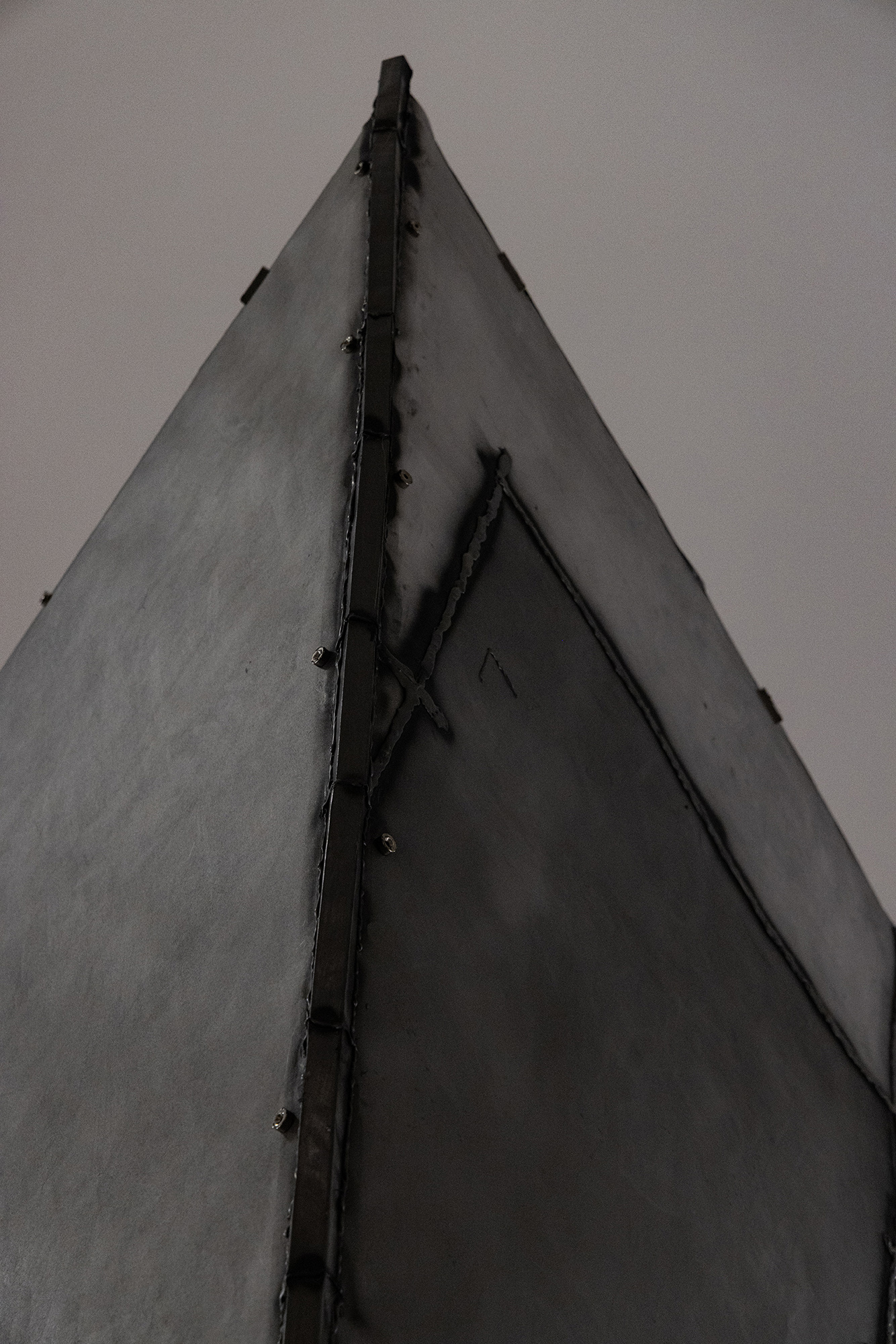
Temporal ventaja es una instalación que invita al espectador a cuestionar las nociones de verdad, realidad y tiempo. La pieza se manifiesta a través de un barco encallado en una plaza comercial, una imagen inquietante que plantea preguntas sobre su origen y propósito. Giaconi construye un relato simbólico donde lo matérico, lo conceptual y lo sensorial se integran para desdibujar los límites entre realidad y ficción.


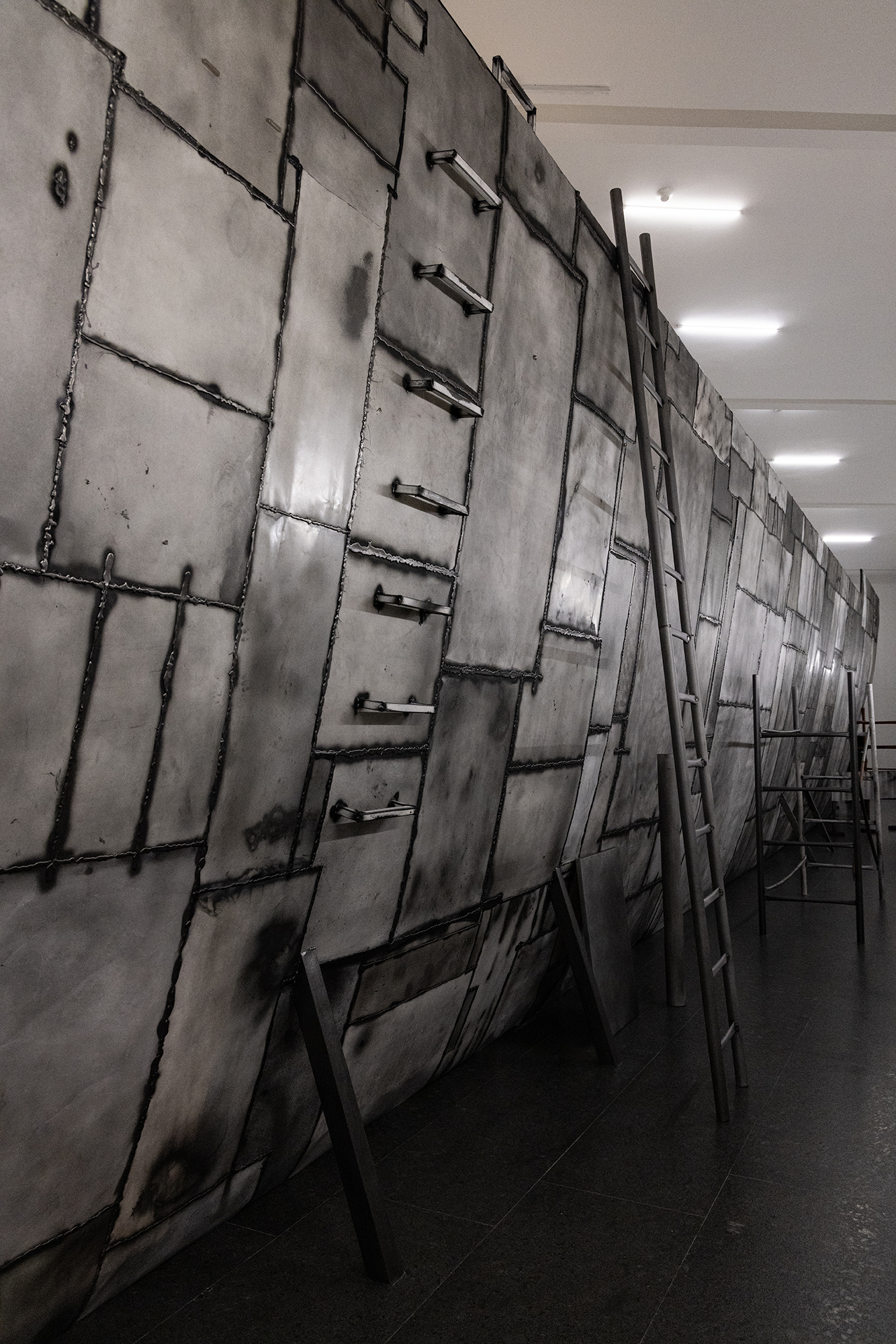


The installation Temporal ventaja (Temporary Advantage) by Mauro Giaconi, commissioned by Arte Abierto, transforms the space into a shipyard that invites us to enter a large-scale ship, stranded in a shopping mall, in a waterless lake city. How does a vessel of this scale end up here?
A builder of narratives, a storyteller, Giaconi provokes and challenges our perception of reality and matter. He creates unique worlds and contexts using a powerful tool: graphite, combined with the strength of collectivity.
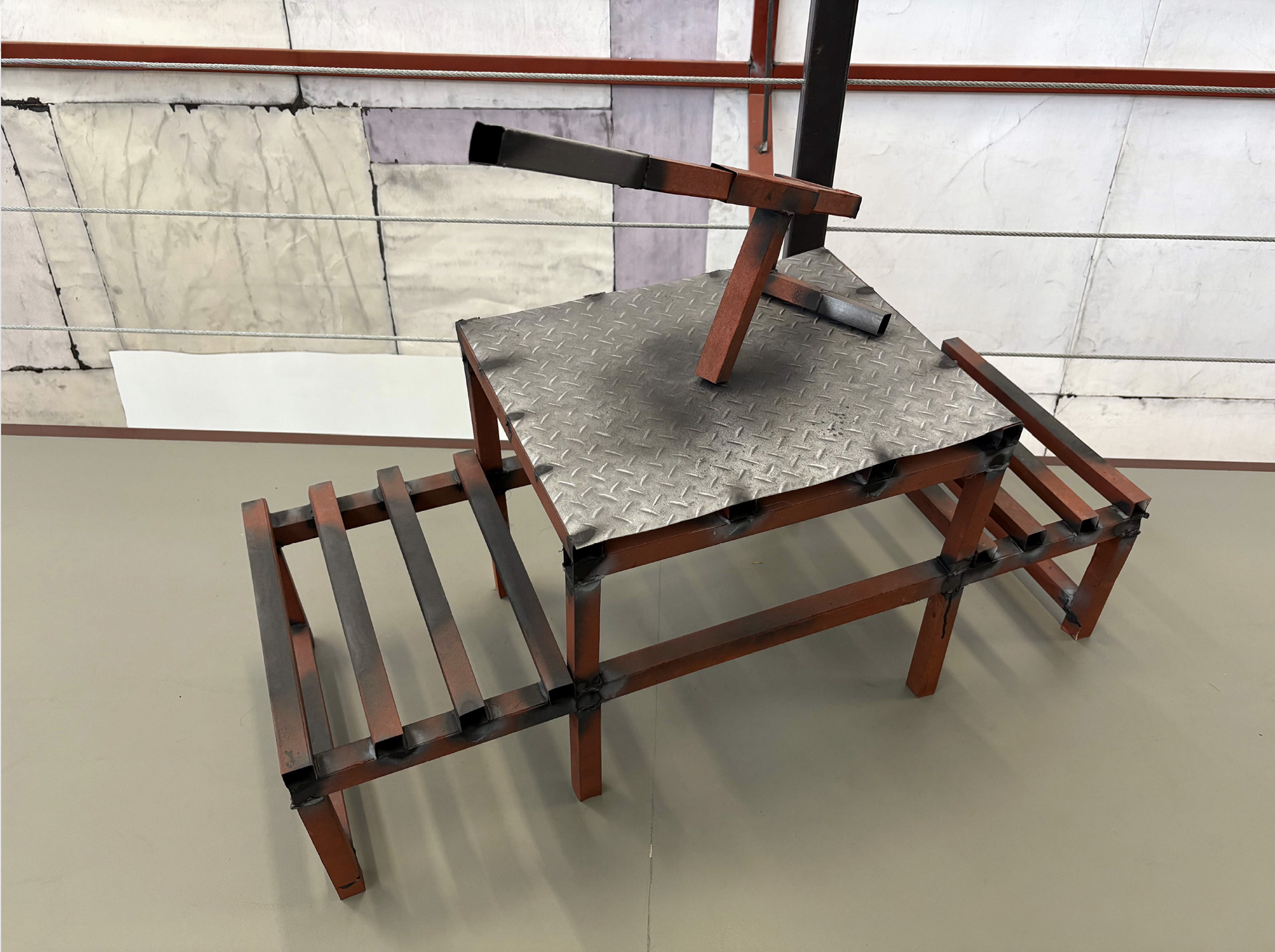
Giaconi conceives drawing as a portable refuge and a space of containment. Through it, he expands into other disciplines—such as sculpture and installation—exploring construction from the fragility of matter as a latent force. In this project, the ship rises as a container of stories and tools, a space of transit and protection that poses the question: is this a place of arrival or departure?
Temporal ventaja invites us to pause in a suspended time where reality and fiction collide, questioning the accepted truths of a present marked by uncertainty and lies. On this journey, the real weakens and constantly blurs, but Giaconi gives us the coordinates to “doubt everything” and return to the origin of human knowledge and wisdom.
Acknowledgments: Gustavo Arróniz, Omar Barquet, Ramiro Chaves, Marcos Castro, Gabriela Correa, Edison Cumes, Tania Candiani, Diego Díaz, Mónica de Haro, Fernando Funcasta, Adriana Funcasta, Ana Gallardo, Vera Giaconi, Federico Gloriani, Eleazar González, Sol Henaro, Enrique Ježik, Alicia Laguna, Valeria Mata, Julio Matadamas, David Medina, Sofía Olascoaga, Guadalupe Salcedo, Javier Sordo, Omar Trejo, Evelyn Useda, Micaela Urrutia, Roberto Velázquez, Laura Vieco, Equipo de Arte Abierto and Obrera Centro.
Team Mauro Giaconi
General Production of the Works: David Medina.
Paulina Carlos Fernández, Clemente Cárcamo Lobato, Francisco García Fragoso, Federico Gloriani, Paulina Granados Carmona, Darinka Lamas, Alan Luna, Julio Matadamas, Rogelio Ortiz Rubio, Víctor Ortiz Ríos, Ramón Salto and the special collaboration of Marcos Castro.
Mauro Giaconi graduated from the National School of Fine Arts “Prilidiano Pueyrredón” (E.N.B.A.P.P., Buenos Aires, Argentina). He has lived and worked in Mexico City since 2011, where he works as a visual artist and independent cultural manager.
His artistic practice explores, through various media such as drawing, graphic intervention, sculpture, and installation, the tension between the real and the apparent. His recent interests focus on appearance and simulation as strategies of resistance, survival, and power, from which he proposes fractures in visual, historical, and political conventions.
His work has been featured in renowned national and international publications; he has participated in various international artist residencies and has exhibited in museums and institutions across the Americas and Europe.
Simultaneously, he works as an independent cultural manager. He is the founder and director of projects such as Obrera Centro, a space for creative encounters and exploration within the artistic community, and HerratecA, a community tool-lending library that functions like a public library but with tools and skills; both are based in Mexico City.
In the field of education, he coordinates independent projects for artistic training, such as Proyecto Imán, seminars on work analysis and artistic production, and DibujE, a study group focused on drawing in contemporary art, among others.
Since 2025, he has been a member of the National System of Art Creators (SNA).
Instagram: @maurogiaconi
Lorem ipsum dolor sit amet, consectetur adipiscing elit, sed do eiusmod tempor incididunt ut labore et dolore magna aliqua. Ut enim ad minim veniam, quis nostrud exercitation ullamco laboris nisi ut aliquip ex ea commodo consequat. Duis aute irure dolor in reprehenderit in voluptate velit esse cillum dolore eu fugiat nulla pariatur.
Lorem ipsum dolor sit amet, consectetur adipiscing elit, sed do eiusmod tempor incididunt ut labore et dolore magna aliqua. Ut enim ad minim veniam, quis nostrud exercitation ullamco laboris nisi ut aliquip ex ea commodo consequat. Duis aute irure dolor in reprehenderit in voluptate velit esse cillum dolore eu fugiat nulla pariatur.
Lorem ipsum dolor sit amet, consectetur adipiscing elit, sed do eiusmod tempor incididunt ut labore et dolore magna aliqua. Ut enim ad minim veniam, quis nostrud exercitation ullamco laboris nisi ut aliquip ex ea commodo consequat. Duis aute irure dolor in reprehenderit in voluptate velit esse cillum dolore eu fugiat nulla pariatur.
Lorem ipsum dolor sit amet, consectetur adipiscing elit, sed do eiusmod tempor incididunt ut labore et dolore magna aliqua. Ut enim ad minim veniam, quis nostrud exercitation ullamco laboris nisi ut aliquip ex ea commodo consequat. Duis aute irure dolor in reprehenderit in voluptate velit esse cillum dolore eu fugiat nulla pariatur.



hacen_EstebanSilva%20_15NOV2025_taller_4.jpg)




Lorem ipsum dolor sit amet, consectetur adipiscing elit, sed do eiusmod tempor incididunt ut labore et dolore magna aliqua. Ut enim ad minim veniam, quis nostrud exercitation ullamco laboris nisi ut aliquip ex ea commodo consequat. Duis aute irure dolor in reprehenderit in voluptate velit esse cillum dolore eu fugiat nulla pariatur.
Block quote
Ordered list
Unordered list
Bold text
Emphasis
Superscript
Subscript


