Lorem ipsum dolor sit amet, consectetur adipiscing elit, sed do eiusmod tempor incididunt ut labore et dolore magna aliqua. Ut enim ad minim veniam, quis nostrud exercitation ullamco laboris nisi ut aliquip ex ea commodo consequat. Duis aute irure dolor in reprehenderit in voluptate velit esse cillum dolore eu fugiat nulla pariatur.


No Sound of Water actúa como un paisaje mineral simulado, como una encarnación física de la forma en que la tecnología ha transformado nuestra relación con la naturaleza y la tierra, una vasta llanura de sal que evoca un paisaje lunar que conduce a una cascada mecanizada de sal más grande que el ser humano .
Aún empequeñecido a la distancia, y apoyado por un sonido distante y rápido, la cascada de sal es borrosa, suave como la seda, de un blanco brillante. Al acercarnos, contrariamente a lo que cabría esperar, su apariencia no se aclara en absoluto y nos hace preguntarnos y buscar pistas sobre cuál puede ser su verdadera composición.
Hay tres elementos principales para la instalación: La llanura de sal que conduce hacia la cascada, la cascada en sí y una gran pantalla LED que presenta una animación por computadora de un robot peludo que corta lo que parece ser el último árbol de la Tierra. Los tres elementos son conceptualmente iguales entre sí, entrelazados e interdependientes, formando una unión que comenta la relación voluble entre el ser humano y la máquina, la naturaleza y la tecnología, uniéndose como un trabajo inmersivo que manipula nuestro sentido de escala, sonido, movimiento, olfato y tacto.
La extensión del paisaje y el tiempo que se tarda en cruzarlo para llegar a la cascada juega un papel importante en el despliegue de las diferentes capas de la instalación. Proporciona un cambio gradual para el visitante desde la posición inicial como observador externo a convertirse en parte inherente de la obra al caminar por el llano. Actúa como un filtro mediante el cual la realidad es una simulación y la tecnología es la lente a través de la cual experimentamos e interpretamos otra versión del mundo, aunque igualmente verdadera.
En un extremo del espacio, la vista bidimensional de la cascada se abre y da paso a una experiencia corporal real. El proceso de caminar en sí es tangible a través del ruido, el olfato y el gusto. El aire salado se seca gradualmente a medida que uno se acerca a la cascada, el sonido del fluido granular que se precipita, fluye y choca, se vuelve más fuerte y supera al crujido de la sal bajo sus pies.
El mecanismo mecanismo que se encarga de acarrear la sal desde el nivel del suelo hasta la parte superior de la cascada, solo para subirla nuevamente una vez que ha descendido; como el trabajo de Sísifo, contribuye a la lectura semántica de la cascada de sal, anclando su origen en el tecnologías extractivas artificiales. La máquina en sí ha sido completamente desarrollada y diseñada por Troika en el transcurso de 3 años, y es capaz de recircular hasta 30.000 kg de sal por hora.
La cascada de sal se coloca en oposición diametral con otra máquina, una pantalla LED medio enterrada en la sal.
Tanto la materialidad como el propósito de estas dos máquinas se completan: la cascada de sal realiza el movimiento de la sal, haciendo que la materia cristalina se mueva, mientras que la pantalla y su LED de sales arrojan luz sobre la escena.
El título No Sound of Water hace referencia al poema "Wasteland" de T. S. Eliot.
Escrito después de la Primera Guerra Mundial, el poema de Eliot describe la desorganización de la sociedad y el papel de la tecnología y la industrialización en la civilización occidental.
Northern Nature is an artistic installation and an environment with plants endemic to Pedregal, and a hydroponic system that will preserve plants for medicinal and culinary use through artificial lighting. In this sense, Open Art will be a totally sensory space where you can smell aromas, perceive textures, recognize colors, feel the temperature and humidity provided by plants and rocks as the living beings that they are. The idea for this garden stems from long-term research that Gabriela Galván has been working on in recent years in relation to the sensitivity and knowledge provided by nature, and especially with a project that she imagined 18 years ago and that finally materializes. His technical and research production has involved working with Open Art for a year, based on an interdisciplinary collaboration with biologists, botanists, geologists and landscape designers.
The proposal takes as its starting point El Pedregal as a site that has been transformed throughout history, starting with the construction of Cuicuilco, one of the most important and oldest cities in the Valley of Mexico (800 BC - 250 AD), buried by lava due to the eruption of the Xitle volcano and whose effect resulted in a volcanic landscape that we can still witness, live and think about. Another key reference is the modernist architecture of the mid-20th century that developed in this area and which responded to a process of modernization of the city, allowing us to think about the different transformations that the Pedregal area has undergone in its different temporalities. Some examples are the Max Cetto Studio House and the Juan and Helen O'Gorman Cave House, where the architectural forms responded to the foundations of the volcanic terrain and where gardens were designed with rocks and plants endemic to the area, thus showing the integration between nature and human development.
The exhibition also seeks to bring us closer to contemplation as an active mental state that, in this case, promotes re-enchantment with the natural world and our awareness of belonging to it. Contemplating nature allows us to know not only the strength of living plants, flowers and rocks, but also the human desire for progress that has led, as is the case of Pedregal, to create, transform and intervene in the environment.
Northern Nature is a living artistic installation that leads the public to rethink and rethink the sense of belonging to nature, recognizing the knowledge that exists in their ways of life. As Gabriela Galván suggests, the project invites us to return to the importance of planting, in a literal and metaphorical sense: “to become one with the manifestation of life, to sow a common good, to sow empathy, to sow conscience, to sow gratitude, amazement and humility”.
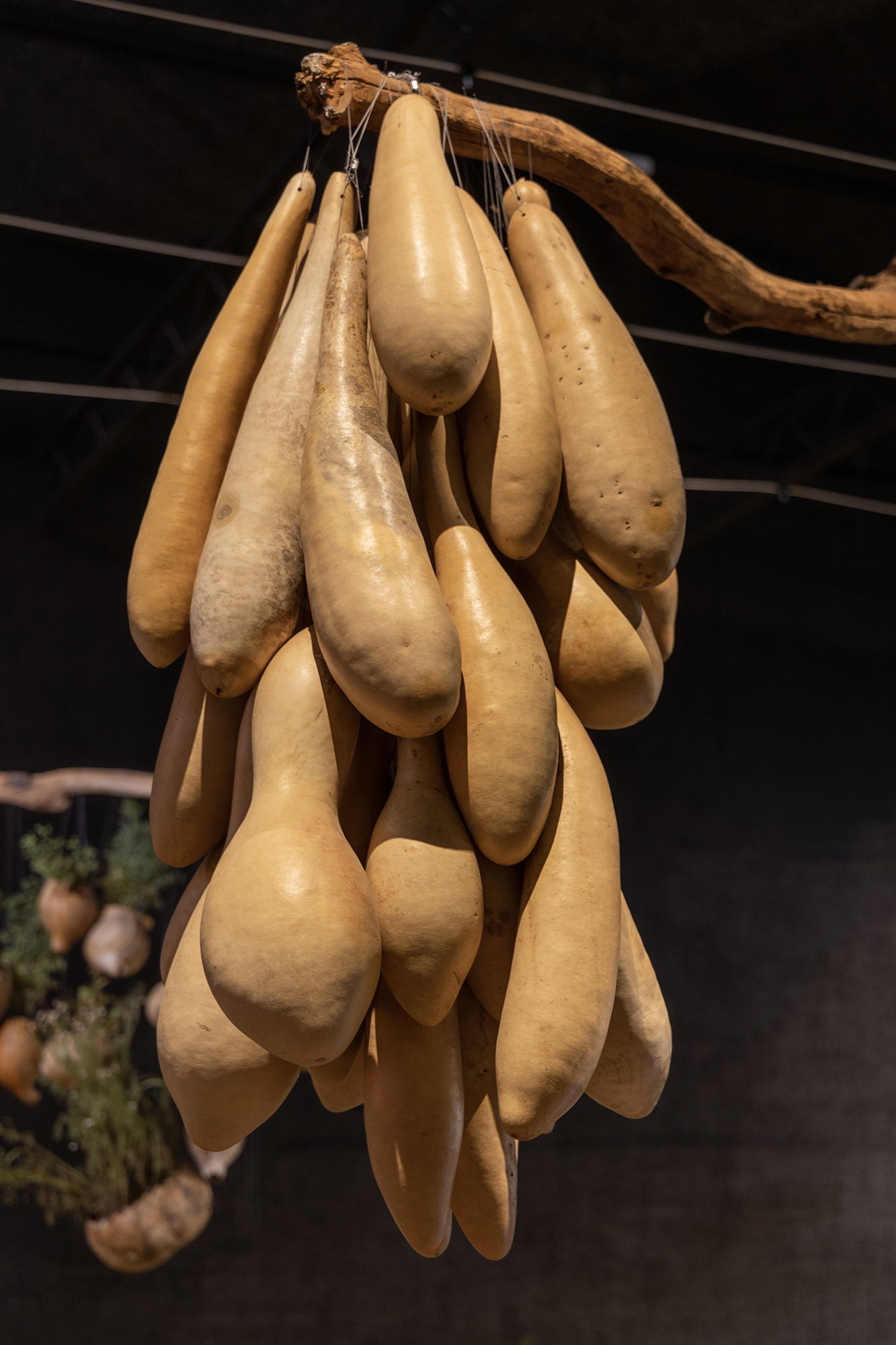
Northern Nature was composed of 3 rooms: An outdoor garden, a semi-interior room and an interior room.
The installation was found in the garden Endemic plants of El Pedregal (2023) open to ARTZ visitors. It is a garden for contemplation and study, for audiences of any age, with the objective of sensitizing people about our relationship with the natural world and for the knowledge of specimens of endemic plants and volcanic stones from El Pedregal, created in collaboration with biologists, geographers and botanists from the Pedregal Reserve.
The semi-interior and interior room was composed of two photomurals and 4 sculptures, which belong to a body of work that I have been developing, which I have called “Venus”. In these works, female characters are presented in relation to nature and stimulate reflection in response to an environmental crisis, with a critical and inclusive vision. The works refer to an aesthetic world of images, possibly familiar to Open Art visitors.
Living plants modify humidity, room temperature, aromas; they will change their size, colors, textures and enhance their function as food; possibly stimulating the awareness of experiencing new relationships with ourselves and with the living beings with whom we relate in this space and in our daily lives.



_1.jpg)
_1.jpg)
_1.jpg)


