
Exhibition
Latidos

Rafael Lozano-Hemmer
07
.
Feb
.
2020
13
.
Dec
.
2020

Rafael Lozano-Hemmer: Pulse Encompassing four major installations that use heart rate sensors to drive kinetic and audio visual responses, the show misuses technologies of identification and determination to create connective experiences that take on an architectural scale.

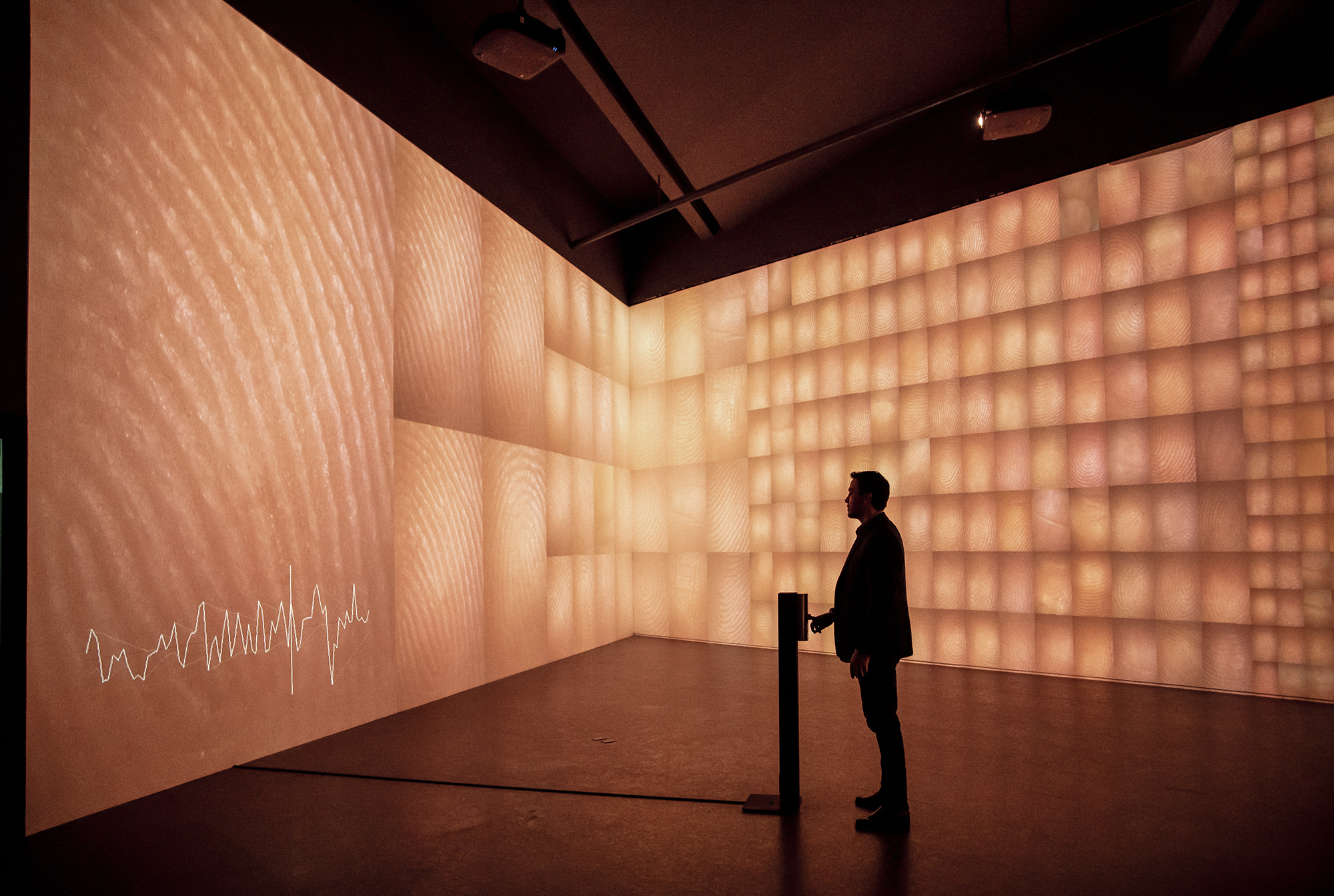
Latidos (Pulse)is the third monographic exhibition on the biometric artwork of the Mexican artist Rafael Lozano-Hemmer (following the Beall Center in Los Angeles in 2010 and Hirshhorn Museum in Washington DC in 2018). 

Encompassing four major installations that use heart rate sensors to drive kinetic and audio visual responses, the show misuses technologies of identification and determination to create connective experiences that take on an architectural scale. In Pulse the vital signs of the public are registered and recorded as repetitive sequences that are visualized as flashing lights, panning soundscapes, waves in ripple tanks, haptic feedback and animated fingerprints.
At the core of each artwork, a sensor detects the biometric signature of each participant. This “portrait” or “snapshot” of the visitor’s intimate electrical activity then gets added to a live archive of other recordings, creating a landscape of syncopated audiovisuals that represent a large group of participants, delivering the individual’s data into a field of collective readings. The emergence of complex non-linear patterns of syncopation, synchronicity and resonance is evident in all the projects and is reminiscent of the minimalist music of Conlon Nancarrow, Glenn Branca or Steve Reich, for example, where repetitive patterns that are slightly offset each other create a grander and ebullient aural phenomenon. 

The new telepresence installation Remote Pulse does not record the heartbeats but instead transmits them across the network between two identical interactive stations where a participant can feel the heartbeat of the other and vice versa.

Conoce más
Texto
A brief timeline of artworks inspired by pulse detection
Por
Rafael Lozano-Hemmer
A brief timeline of artworks inspired by pulse detection
Por

Throughout the centuries and across innovations in audiovisual and bio-technologies, artists have explored new ways to record, replicate, and magnify the human heartbeat. The following works, chosen by Rafael Lozano-Hemmer, offer a glimpse into the extent of this collaboration between art and technology and the various meanings revealed in the intimate measure of a pulse.

1957  Paul Taylor, Panorama

In this piece by American choreographer Paul Taylor, three performers danced to recorded heartbeat sounds.

1962  Chris Marker, La Jetée (The Jetty)

The soundtrack for this science fiction masterpiece by French filmmaker Chris Marker featured prominent use of dramatic heartbeats throughout, which take particular importance as the film is composed of still images.

1966  Mark Boyle y Joan Hills, Son et Lumière for Bodily Fluids and Functions

This series of projection-based performances across the United Kingdom ambitiously attempted to incorporate all bodily materials in existence. It consisted of projections of bodily fluids such as tears, saliva, sperm, vomit, and urine, accompanied by a score of amplified body sounds, including heartbeats. All materials and sounds were collected and projected in real time.

1966   Brian O’Doherty, Portrait of Marcel Duchamp: Lead 1, Slow Heartbeat

Irish artist Brian O’Doherty recorded an electrocardiogram of Marcel Duchamp’s heartbeat and animated it with flickering light inside a small wooden box.

1967   Richard Teitelbaum, MEV Concerts

A pioneer of music produced by brainwaves, American composer Richard Teitelbaum co-founded the free improvisation ensemble Musica Elettronica Viva (MEV) with Alvin Curran and Frederic Rzewski. They produced numerous musical performances used biofeedback circuitry connected to brainwave sensors, heart rates, EMGs, skin conductivity, and other devices. Members of the audience frequently participated in the concerts.

1968   Jean Dupuy, Heart Beats Dust

In a collaboration facilitated by Experiments in Art and Technology (E.A.T.), a nonprofit organization designed to connect artists with new industrial technologies, French artist Jean Dupuy and American engineer Ralph Martel created a sculpture consisting of a glass cube filled with dust particles that are activated by the sound of a beating human heart.

1969   John Lennon and Yoko Ono, Baby’s Heartbeat

A track in the experimental album Unfinished Music No. 2 :, Life with the Lions featured the foetal heartbeat of Ono and Lennon’s unborn son, John Ono Lennon II, before Ono’s miscarriage. The recording was made with a Nagra audio recorder.

1970   Juan Downey, Inflatable Chairs

For a show at Howard Wise’s experimental media art gallery in New York, Chilean artist Juan Downey designed chairs that inflated and deflated in sync with the breathing and heartbeat of their occupants.

1971–2001 Merce Cunningham, Loops

Composer Gordon Mumma created a score that amplified dancer/choreographer Merce Cunningham’s breathing and heartbeat during live performances of Loops, a solo work that Cunningham performed from 1971 through 2001. Although Cunningham never had another dancer perform the work, he collaborated from 2001 to 2011 with digital artists Marc Downie and Paul Kaiser, together known as OpenEndedGroup, to create several virtual versions of the piece.

1971 Heinz Holliger, Cardiophonie

Swiss composer and oboist Heinz Holliger attached an amplified stethoscope to a wind instrument, adding the soloist’s pulse to the music.

1971 Jack Goldstein, The Burial

For his California Institute of the Arts master's thesis exhibition, Canadian-born artist Jack Goldstein had himself buried alive on a hill overlooking a Los Angeles freeway. The burial location was marked with a small beacon that pulsed in time with Goldstein's heartbeat, using data gathered from a stethoscope attached to the artist's chest.

1972   Teresa Burga, Autorretrato. Estructura. Informe. 9.6.1972 (Self-portrait. Structure. Report. 9.6.1972 )

This sprawling multimedia installation portrays Peruvian artist Teresa Burga through her medical data. In addition to diagrams, photographs, and medical records, the installation included a phonocardiogram, which made Burga's heartbeat a visible and audible component of the work.

1973   Pink Floyd, Dark Side of the Moon

This seminal album by the British band Pink Floyd began and ended with a heartbeat.

1974   Pauline Oliveros, Sonic Meditations

In this pioneering document of avant-garde musical thought, the composer asked participants to form all the sounds of their environment into a musical drone, and then to include internal sounds such as blood pressure and heartbeat in order to listen to listening. 

1977 Ann Druyan, Interstellar Message Project

When Voyager 1 launched in 1977, the space probe carried a gold phonograph record containing sounds and images that represented life on Earth, including the recorded heartbeat and brainwaves of Ann Druyan, creative director of NASA’s Voyager Interstellar Message Project.

1978   Sandra Llano-Mejía, In Pulso (In Pulse)  

For her 1978 video work, created in the Physics Department of the Autonomous Metropolitan University in Mexico City, Colombian video art pioneer Sandra Llano-Mejía placed electrodes on her body and used an electrocardiograph machine to visualize the data on graph paper and a video monitor.

1979   Diana Domingues, Electrourbs

In this work by Brazilian media artist Domingues at the N.O Space in Porto Alegre, visitors used an electronic stethoscope connected to amplifiers to make a sonic landscape of their hearts. An oscilloscope was also employed to visualize the heartbeats as electrical waves in the exhibition space.

1983   Bill Viola, Science of the Heart

A human heart was projected behind an illuminated bed in Bill Viola’s installation Science of the Heart. The audible heartbeat and the video sped up and slowed down as the piece unfolded in time.

1991   Jonathan Borofsky, Heart Light

A sculpture comprised of a glowing red orb mounted on a tripod, Borofsky’s work flashes to the rhythm of the artist’s heartbeat while embedded speakers emit its sound. For Borofsky, this visualization of his own pulse data was an attempt to convey a spiritual presence.

1992   Seiko Mikami, Borderless Under the Skin

Housed in a biohazard tent, Seiko Mikami’s installation consists of IV drip bags that contain surgical gloves. As sensors collect the heartbeats of the visitors, the fingers of the gloves light up. Each IV drip bag is labeled with information about the transmission of a specific viral disease.

1992–1993   Ulrike Gabriel, Breath

German artist Ulrike Gabriel’s interactive projection relies on a biofeedback system that uses sensory belts to record the breathing patterns of visitors and create a visual and acoustic response in real time. The resulting computer-generated composition of oscillating polygons responds to the frequency and volume of breath, becoming, inversely, more complex and chaotic as the breathing becomes more regular.

1993   Christian Möller, Light Blaster: Immaterial Membrane

This interactive light and sound installation uses a fiber optic cable, a laser, and an electronic pulse and oxygen monitor to transform a visitor’s heartbeat into a pulsating audiovisual light show.

1994–1995   Jim Campbell, Memory Works: Portrait of My Father

In the mid-1990s, San Francisco–based artist Jim Campbell incorporated his breath and heartbeat into works dedicated to his recently deceased parents. In the first, a portrait of Campbell’s father appears and disappears to the rate of the artist’s heartbeat.

1996-1997  Stelarc, Amplified Body

In his performances, Australian artist Stelarc used sensors to allow lighting installations to flicker and flare in response to measurements of the electrical discharges from brainwaves (EEG), muscles (EMG), pulse (plethysmogram) and blood flow (doppler flow meter).

1997   Catherine Richards, Charged Hearts

In this site-specific, interactive work created by Canadian artist Catherine Richards for the National Gallery of Canada, visitors were invited to step onto a glass floor, reach into a cabinet, and pick up a glass heart. When touched, electrons in the heart became excited and turned phosphorescent, externally simulating the electromagnetic operations of the heart.

1998   Char Davies, Ephémère (Ephemeral)

The second in a pair of virtual reality works that Canadian artist Char Davies created in the 1990s, Ephémère is an interactive installation that measures the breathing and balance of the participants and immerses them in an environment that shifts back and forth between a natural landscape and the interior of a human body.

2001   Antonia Hirsch, Pulse

German-Canadian artist Antonia Hirsch created an installation in which a heart’s contractions, seen on a radar screen, occurred in sync with an audible universal time signal, and then grew apart.

2003  Noriyuki Fujimura, Heartbeats

An interactive art performance consists of balloons that light up to the heartbeat of the participant, who holds a sensor placed at the end of the balloon's rope.

2004  Diana Domingues, Heartscapes

Heartscapes by Brazilian artist Diana Domingues is an immersive virtual environment in which heart rate sensors allow participants to modify the visuals and sounds inside a VR projection CAVE environment.

2006  Rafael Lozano-Hemmer, Almacén de Corazonadas (Pulse Room)

The first piece in Lozano-Hemmer’s series of works using the pulse premiered at the abandoned La Constancia textile factory in Puebla, Mexico. One hundred bulbs flickered, showing the pulse of the past one hundred participants. The piece has been shown at different scales, depending on the venue, and, since 2008, it includes a sound component.

2006 Peter Votava and Erich Berger aka Terminalbeach, Heart Chamber Orchestra

The artist duo known as Terminalbeach devised this audiovisual performance in which the heartbeats of twelve classically trained musicians create a “living score.”

2007   Rafael Lozano-Hemmer, Pulse Front

Pulse Front was a matrix of light over Toronto's Harbourfront neighbourhood, made with light beams from twenty powerful robotic searchlights, entirely controlled by a network of sensors that measured the heart rate of passers-by.

2008  Christian Boltanski, Les Archives du Coeur (The Heartbeat Archive)

For the past decade, French Conceptual artist Christian Boltanski has been amassing an archive of recordings of heartbeats collected from people around the globe. Les Archives du Coeur is housed at the Benesse Art Site on Teshima Island in Japan.

2008  Rafael Lozano-Hemmer, Pulse Tank

First presented at the first New Orleans Biennial, Pulse Tank takes the familiar scientific apparatus of the ripple tank to visualize the heartbeats.

2010   Aurel de Coloblo Mendoza, La Cámara de Descompresión Urbana (Urban Decompression Chamber)

Described as an "itinerant sensory experiment," this work by French artist Aurel de Coloblo Mendoza is a soundproof booth built inside of a truck that traveled to several locations in Mexico City. Visitors were wired with an electronic stethoscope and invited to enter the booth alone, where they sat in the dark, listening to the amplified sounds of their own heartbeats.

×
Texto
Border Tuner
Por
Rafael Lozano-Hemmer
Border Tuner
Por

Border Tuner is a large-scale, participatory art installation designed to interconnect the cities of El Paso, Texas, and Ciudad Juárez, Chihuahua. Powerful searchlights make “bridges of light” that open live sound channels for communication across the US-Mexico border. The piece creates a fluid canopy of light that can be modified by visitors to six interactive stations, three placed in El Paso and three in Juárez.

Each of the interactive Border Tuner stations features a microphone, a speaker and a large wheel or dial. As a participant turns the dial, three nearby searchlights create an “arm” of light that follows the movement of the dial, automatically scanning the horizon. When two such “arms of light” meet in the sky and intersect, automatically a bidirectional channel of sound is opened between the people at the two remote stations. As they speak and hear each other, the brightness of the “light bridge” modulates in sync, —a glimmer similar to a Morse code scintillation. Every interactive station can tune any other, so for example a participant in Mexico can connect to the three US-based stations or to the other two in Mexico, as they wish.

Border Tuner is not only designed to create new connections between the communities on both sides of the border, but to make visible the relationships that are already in place: magnifying existing relationships, conversations and culture. The piece is intended as a visible “switchboard” of communication where people can self-represent. The project seeks to provide a platform for a wide-range of local voices and an opportunity to draw international attention to the co-existence and interdependence between the sister cities that create the largest bi-national metropolitan area in the western hemisphere.

×
Video
Latidos
Por
Rafael Lozano-Hemmer
Latidos
Por
×
Video
Latidos
Por
Rafael Lozano-Hemmer
Latidos
Por
×
Selección de obras
Remote Pulse, 2019
De la serie
Biometric art
Stainless steel base, Corian front plate, heart rate sensor boards, circuits, transducers, light bulbs
+
Pulse Index, 2010
De la serie
Installation
ND
+
Pulse Tank, 2008
De la serie
Installation
ND
+
Pulse Room, 2006
De la serie
Installation
ND
+
Recorrido por la exposición con Troika
Video
5'35''
Programa Público